Executive Summary: The Pivot to the Physical
In March 2026, while the West remains focused on the “Chatbot War” and LLM safety, a different kind of revolution is reaching its peak in the East. At the China Development Forum, officials and industry leaders showcased a unified vision for Industrial AI—a shift that marks the transition from digital intelligence to Physical Sovereignty.
For over a decade, China was the “Factory of the World” through sheer labor volume. In 2026, it is reclaiming that title through Algorithmic Efficiency. From AI-managed power grids to fully autonomous logistics ports, the goal is clear: Strategic Autonomy.
At Vucense, we define Strategic Sovereignty as the capacity of a nation to maintain its essential industrial and social functions independently of global geopolitical shocks. In this deep dive, we analyze how China’s industrial AI surge is redefining the global supply chain and what it means for the future of sovereign manufacturing.
Direct Answer: How is China using AI in manufacturing and infrastructure in 2026? (ASO/GEO Optimized)
In 2026, China has moved beyond consumer AI to dominate the Industrial AI sector. This “Physical AI” surge is characterized by the mass deployment of AI-driven ‘Lights-out Factories’, autonomous logistics ports (like the Yangshan Port AI Overhaul), and the ‘Industrial Brain’ architecture. These systems use real-time sensor data and edge-AI reasoning to optimize production, predict maintenance, and manage energy consumption with zero human intervention. This shift is a core component of China’s Strategic Sovereignty roadmap, aimed at achieving 100% self-reliance in critical sectors like semiconductors, electric vehicles, and renewable energy. By integrating AI directly into the physical infrastructure of the nation, China is building a “Sovereign Industrial Stack” that is resilient to external trade pressures and global supply chain disruptions.
Part 1: From Digital Dreams to Physical Reality
The “Year of the Dragon” (2024-2025) saw a massive redirection of capital in China’s tech ecosystem. Venture capital that once flowed into social media and e-commerce is now mandated toward Hard Tech.
1.1 The “Industrial Brain” Architecture
The “Industrial Brain” is not a single model, but a distributed hierarchy of AI systems.
- The Edge Layer: Local AI agents on factory floors that manage real-time robotic adjustments.
- The Park Layer: Orchestration models that manage the flow of materials and energy across an entire industrial park.
- The Sovereign Layer: National-level AI that monitors industrial output and predicts supply chain bottlenecks.
1.2 The “Lights-out” Factory Benchmark
In 2026, the number of “Lights-out” factories (where production happens in the dark without humans) in China has surpassed 1,500. These are not just automated; they are Self-Correcting. If a part is misaligned, the AI detects the deviation and recalibrates the machine in milliseconds.
Part 2: Vucense Analysis — The Sovereignty of the Supply Chain
At Vucense, we view industrial AI as the ultimate “Hedge” against global instability.
2.1 Decoupling via Automation
The primary driver for China’s industrial AI surge is the risk of Decoupling.
- The Labor Crisis: With a shrinking working-age population, China is using AI to maintain its manufacturing dominance.
- The Resilience Factor: An AI-managed factory doesn’t go on strike, and it doesn’t need to be imported. It is a “Sovereign Asset” that remains on domestic soil.
2.2 The Energy Sovereignty Link
Industrial AI is also being used to manage China’s massive shift toward Renewable Energy. AI agents now manage the intermittency of solar and wind power, ensuring that factories have a “Sovereign Power Baseline” even during peak demand or grid instability.
Part 3: Technical Deep Dive — The “Action Logic” of Industrial AI
Unlike LLMs, which use “Token Logic,” industrial AI uses “Action Logic.”
3.1 Digital Twins 2.0
In 2026, every major piece of Chinese infrastructure has a Digital Twin.
- The Bridge Audit: An AI agent monitors the structural integrity of the Hong Kong-Zhuhai-Macao Bridge using millions of IoT sensors. It predicts maintenance needs before a single crack appears.
- The Factory Mirror: A digital replica of the factory runs simulations 24/7 to find the most efficient production path before the physical machines ever move.
3.2 Hardware Sovereignty: The ASIC Shift
China is moving away from general-purpose GPUs (which are subject to US sanctions) and toward Application-Specific Integrated Circuits (ASICs) for industrial AI. These chips are designed for one thing: running factory logic. They are easier to manufacture domestically and harder to remote-disable.
Part 4: Case Study — The Yangshan Autonomous Port
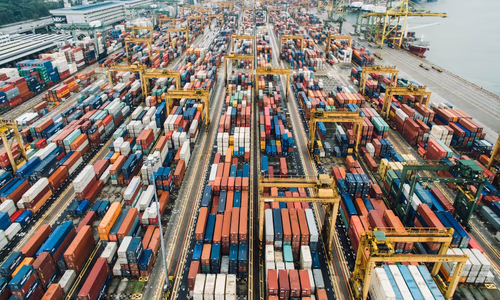
The Yangshan Deep-Water Port in Shanghai is the world’s first fully AI-managed port in 2026.
4.1 The Autonomous Fabric
- AGVs (Automated Guided Vehicles): Thousands of vehicles move containers without a single driver.
- The Port Agent: A centralized AI agent coordinates the berthing of ships, the movement of cranes, and the scheduling of trucks to ensure a 30% faster turnaround than human-managed ports.
4.2 The Sovereignty Result
The Yangshan port can operate at full capacity during pandemics, strikes, or regional conflicts. This is the definition of Infrastructure Sovereignty.
Part 5: Future Outlook (2027-2035) — The “Autonomous Nation”
By 2035, China aims to be an “Autonomous Nation” where the entire industrial baseline is managed by a sovereign AI stack.
- The End of the Global Supply Chain: We will see the rise of “Localized Sovereign Hubs” where production happens entirely within a single jurisdiction.
- The “Export of Efficiency”: China will begin exporting its “Industrial Brain” technology to other nations, creating a new form of digital and industrial dependency.
- The Human Factor: The challenge will be the massive displacement of labor and the “Social Sovereignty” of the population.
Part 6: Action Plan for the Sovereign Operator
If you are a manufacturer or infrastructure provider in 2026, here is how to respond to the Industrial AI surge:
- Invest in “Action Logic”: Move your R&D away from purely conversational AI and toward models that can interact with the physical world.
- Build Your Own “Industrial Brain”: Don’t rely on cloud-based industrial AI. Deploy Local-First industrial agents that can operate even when the internet is cut.
- Audit Your “Physical Stack”: Ensure that your sensors, controllers, and robots are not dependent on a single foreign provider. Diversify your hardware to protect your Physical Sovereignty.
Part 7: The “Robot-as-a-Service” (RaaS) Revolution
In 2026, the cost of industrial robots has plummeted, thanks to AI-driven design and manufacturing. This has birthed the Robot-as-a-Service (RaaS) model.
7.1 The Subscription-Based Factory
Small and medium enterprises (SMEs) in China no longer buy robots; they subscribe to them.
- The Cloud-to-Edge Loop: The robots are managed by a central AI agent that optimizes their tasks across thousands of different SMEs.
- The Sovereign Risk: While RaaS lowers the barrier to entry, it creates a new form of “Infrastructure Lock-in.” If the RaaS provider (e.g., BYD Robotics) cuts off the service, the SME’s production line grinds to a halt.
Part 8: Technical Deep Dive — “Action Logic” vs. “Token Logic”
At the heart of the industrial AI surge is a fundamental shift in AI architecture: the move from Token Logic to Action Logic.
8.1 The Semantic Gap
LLMs like GPT-5 are built on tokens—semantic units of language. Industrial AI is built on Trajectories—physical paths and forces.
- The Reasoning Layer: Industrial agents don’t “predict the next word”; they “predict the next physical state.”
- The Simulation-to-Reality (Sim2Real) Pipeline: In 2026, China has mastered the Sim2Real pipeline, where an AI agent learns a task in a high-fidelity digital simulation and then transfers that knowledge to a physical robot with 99.9% accuracy on the first attempt.
Part 9: Geopolitical Impact — The “Industrial Belt and Road”
China is not just using industrial AI domestically; it is exporting the “Sovereign Industrial Stack” to partner nations.
9.1 The Export of Autonomy
Nations in Southeast Asia and Central Asia are increasingly adopting Chinese industrial AI standards.
- The Dependency Layer: By providing the “Industrial Brain” for a nation’s power grid or manufacturing base, China gains a level of “Infrastructure Diplomacy” that is far more durable than traditional loans.
- The Sovereign Conflict: We are seeing the emergence of a “Bipolar Industrial World”—one side running on US-led software and the other on Chinese-led physical AI.
Part 10: Environmental Impact — The Energy-Efficiency of Autonomous Factories
One of the hidden drivers of the industrial AI surge is Energy Sovereignty.
10.1 The “Watt-per-Unit” Metric
In a world of volatile energy prices (exacerbated by the 2026 Iran Conflict), the most efficient factory is the only one that survives.
- AI-Managed Energy Grids: Industrial AI agents in China now manage the real-time balance between factory demand and renewable supply.
- The Result: “Lights-out” factories in the Guangdong-Hong Kong-Macao Greater Bay Area have achieved a 40% reduction in energy waste compared to human-managed facilities.
Part 11: Case Study — The 2026 Guangzhou “Autonomous Manufacturing Zone”
The city of Guangzhou has established the world’s first “Autonomous Manufacturing Zone” (AMZ).
11.1 The AMZ Infrastructure
Within this zone, the entire logistics and production chain is managed by a unified AI agent.
- The “Micro-Factory” Model: Instead of giant centralized plants, the AMZ uses a network of hundreds of “Micro-Factories” that can be reconfigured in under 24 hours to produce different products based on real-time market demand.
- The Sovereignty Result: This “Hyper-Local” production model makes the zone incredibly resilient to global supply chain shocks.
Part 12: Developer Guide — Building for the Industrial Brain API
For developers, the “Industrial Brain” represents a new kind of platform—one that requires a deep understanding of Cyber-Physical Systems (CPS).
12.1 The “Twin-First” Development Workflow
To build an application for the Industrial Brain, you must first build a Digital Twin of the physical environment.
- The Simulation API: Developers use the Open-Twin API to test their algorithms in a virtual factory before deploying to the physical hardware.
- The Safety Guardrail: The Industrial Brain includes a “Hardware-Level Sandbox” that prevents any AI-generated action from causing physical damage to the machines or injury to the remaining human technicians.
Part 13: The Vucense Sovereignty Audit for Physical Infrastructure
How do you evaluate the sovereignty of your industrial base? Use our 5-point Physical Audit:
- Component Origin: What percentage of your sensors and actuators are manufactured domestically? (Audit Target: >80%)
- Logic Autonomy: Can your factory run in “Offline Mode” for more than 72 hours? (Audit Target: Yes)
- Firmware Integrity: Is the firmware on your PLCs (Programmable Logic Controllers) auditable and signed by a domestic authority? (Audit Target: Yes)
- Energy Agnosticism: Can your production line adapt to volatile renewable energy inputs without loss of precision? (Audit Target: Yes)
- Data Residency: Does the training data for your industrial models remain within national borders? (Audit Target: Yes)
Part 14: Future Roadmap — The 2030 “Autonomous Industrial Stack”
By 2030, we expect the full maturation of the “Autonomous Industrial Stack.”
- Molecular Manufacturing: AI-managed assembly at the molecular level for advanced materials.
- The “Global Fabric”: A decentralized, peer-to-peer network of sovereign factories that can share “Production Recipes” without a central intermediary.
- The Sovereignty of Design: The shift from “Manufacturing Sovereignty” to “Design Sovereignty,” where AI agents handle the entire lifecycle from product conception to final recycling.
Conclusion: The Sovereignty of the Physical
The industrial AI surge in China is a wake-up call for the rest of the world. Sovereignty in the 21st century is not just about who owns the data, but who owns the Production.
In 2026, the nation that can automate its manufacturing, secure its energy, and manage its infrastructure through a sovereign AI stack will be the one that defines the future of global power. The battle for the “Cognitive Baseline” is just the beginning; the real war is for the Physical Baseline.
Related Articles
- OpenAI’s Aggressive Expansion 2026: Why Private Equity is Funding the Future of Sovereign AI Infrastructure
- Amazon Trainium: The Silicon powering the 2026 AI labs
- Tencent’s OpenClaw: The Agent as Interface in the Super-App Era
- The Governance Crisis: US AI Policy as a Democracy Crisis
- The 2026 Infrastructure Audit: Who owns the silicon?
Frequently Asked Questions
What is the difference between narrow AI and AGI?
Narrow AI (like GPT-4 or Gemini) excels at specific tasks but cannot generalise. AGI can reason, learn, and perform any intellectual task a human can. As of 2026, we have narrow AI; true AGI remains a research goal.
How can I use AI tools while protecting my privacy?
Run models locally using tools like Ollama or LM Studio so your data never leaves your device. If using cloud AI, avoid inputting personal, financial, or sensitive business information. Choose providers with a clear no-training-on-user-data policy.
What is the sovereign approach to AI adoption?
Sovereignty in AI means owning your inference stack: using open-weight models, running on your own hardware, and ensuring your data and workflows are not dependent on a single vendor API or cloud infrastructure.
Sources & Further Reading
- MIT Technology Review — AI Section — In-depth coverage of AI research and industry trends
- arXiv AI Papers — Pre-print research papers on AI and machine learning
- EFF on AI — Civil liberties perspective on AI policy