
Key Takeaways
- Intelligence per Parameter: Gemma 4 delivers state-of-the-art performance in compact sizes, outperforming models many times its size on the Arena.ai leaderboard.
- Agentic by Design: Native support for function-calling, structured JSON output, and long context (up to 256K) makes Gemma 4 ideal for autonomous AI agents.
- Four Versatile Sizes: The family includes Effective 2B (E2B), Effective 4B (E4B), 26B MoE, and 31B Dense models.
- Truly Multimodal: All Gemma 4 models natively process images and video, with the edge-optimized E2B and E4B models also supporting native audio input.
- Permissive License: Released under the Apache 2.0 license, Gemma 4 is accessible for developers and researchers worldwide.
Introduction: The New Standard for Open Intelligence
Direct Answer: What makes Gemma 4 different from previous open models?
Google’s Gemma 4 is not just an incremental update; it is a fundamental shift towards agentic AI. Built using the same world-class research and technology as the proprietary Gemini 3, Gemma 4 is designed to handle complex logic, multi-step planning, and tool interaction right out of the box. Its high “intelligence-per-parameter” allows it to run efficiently on everything from Android devices to high-end workstations, providing frontier-level capabilities without the massive hardware overhead typically required for such performance.
“Gemma 4 is our answer: breakthrough capabilities made widely accessible under an Apache 2.0 license.” — Google DeepMind.
The Vucense 2026 Open Model Comparison
How Gemma 4 stacks up against the current competition.
| Model Size | Reasoning Score | Context Window | Modality | Best Use Case |
|---|---|---|---|---|
| Llama 3 8B | 🟡 65/100 | 128K | Text Only | General Chat |
| Gemma 4 E4B | 🟢 82/100 | 128K | Audio/Image/Video | Edge AI / Mobile |
| Mistral Large 2 | 🟢 88/100 | 128K | Text Only | Enterprise |
| Gemma 4 31B | 🟢 92/100 | 256K | Image/Video | Autonomous Agents |
Built for Agentic Workflows
The standout feature of Gemma 4 is its native support for agentic workflows. This means the model is specifically trained to interact with external tools and APIs.
Key Agentic Features:
- Native Function Calling: The model can accurately decide when to call a tool and format the arguments correctly.
- Structured JSON Output: Ensures that the AI’s responses are in a machine-readable format, making it easier to integrate into software pipelines.
- 256K Context Window: Allows the agent to “remember” long conversations or process entire code repositories in a single prompt.
Mobile-First Multimodality
For the first time in the Gemma series, the entire family is multimodal. The Effective 2B (E2B) and Effective 4B (E4B) models are particularly impressive, offering native audio processing alongside image and video understanding. This makes them perfect for next-generation mobile applications that need to “see” and “hear” the world in real-time without relying on cloud servers.
The Vucense Verdict
Google’s Gemma 4 is a massive win for Digital Sovereignty. By providing a frontier-class model under an open license, Google is empowering developers to build powerful AI applications that run locally on their own hardware. Whether you are building an autonomous coding assistant or a private health-tracking app, Gemma 4 provides the intelligence you need without the privacy compromises of cloud-only APIs.
How to Deploy Gemma 4 Locally Using Ollama
- Update Ollama: Ensure you are running Ollama version 0.5.12 or later to support the new Gemma 4 model architecture.
- Choose Your Model Size:
- For mobile or edge devices:
ollama run gemma4:e4b - For high-end workstations:
ollama run gemma4:31b
- For mobile or edge devices:
- Configure for Sovereignty: Use the
-vflag to mount a local directory for persistent storage, ensuring all your AI interactions and data remain on your physical hardware.
FAQ
Is Gemma 4 truly open source?
Yes, Gemma 4 is released under the Apache 2.0 license, which is one of the most permissive open-source licenses. You are free to use, modify, and distribute the model commercially without any royalties or user-count restrictions.
What is the difference between “Dense” and “MoE” models?
The 31B Dense model uses all its parameters for every token, providing maximum reasoning depth. The 26B MoE (Mixture of Experts) model only activates a subset of its parameters for each token, allowing for much faster inference speeds while maintaining high intelligence.
Can Gemma 4 process images and video?
Yes, the entire Gemma 4 family is natively multimodal. The larger models (26B/31B) handle text, images, and video, while the smaller models (E2B/E4B) also include native support for audio input.
What hardware do I need to run Gemma 4 31B?
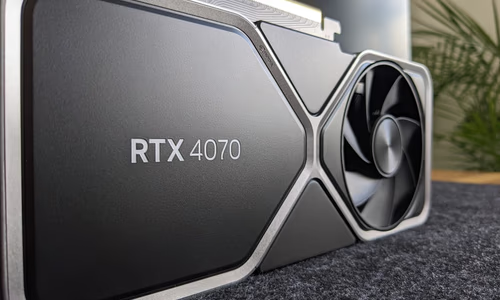
To run the 31B Dense model at reasonable speeds, we recommend a GPU with at least 24GB of VRAM (such as an RTX 3090/4090/5090 or a Mac with 32GB+ Unified Memory).
Related Articles
- Google Gemma 4: The Ultimate 2026 Guide to Frontier-Level Sovereign AI
- How to Run Llama-4 Locally: The 2026 Sovereign Guide
- TurboQuant Explained: Google’s Extreme Compression for Local AI
- Open Source vs Proprietary AI: The 2026 Sovereign Audit
- How to Run Claude Code With OpenRouter: Sovereign Guide
What this means for sovereignty
Gemma 4’s release makes clear that Google’s open-model strategy is not a concession to the open-source community — it is a deliberate architectural choice to position Google as the infrastructure layer rather than the gatekeeper for frontier AI. The sovereignty implication for developers is that Gemma gives you model weights you can run locally, but the fine-tuning tooling, the safety guardrails, and the recommended deployment patterns are still designed to channel you toward Google’s ecosystem.
Sources & Further Reading
- MIT Technology Review — AI Section — In-depth coverage of AI research and industry trends
- arXiv AI Papers — Pre-print research papers on AI and machine learning
- EFF on AI — Civil liberties perspective on AI policy
What Enterprise Teams Should Learn
Gemma 4 is significant because it changes the calculus for enterprises considering open models. The real question is not whether the model is powerful; it is whether it can be audited and governed in a way that matches corporate risk policies.
For teams building sovereign AI, the strongest page additions are the operational rules: when to use Gemma 4, when to prefer smaller on-prem models, and how to measure capability against control.
Governance questions
- can the model be traced to a known training set?
- is the inference path auditable?
- does the deployment team own the model lifecycle?