Key Takeaways
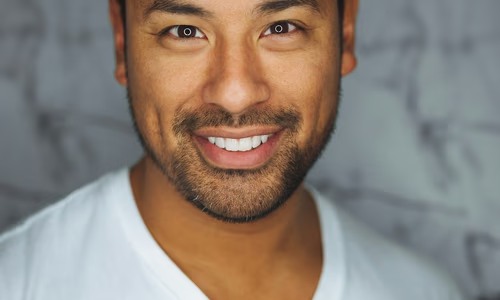
- The Deal: OpenAI has acquired TBPN (Technology Business Programming Network), the live founder-led talk show hosted by John Coogan and Jordi Hays.
- The Promise: OpenAI says TBPN will continue as its own brand and retain editorial independence, including control over programming and guest selection.
- The Tension: Once the deal closes, TBPN will operate under OpenAI’s strategy team and report to Chris Lehane, one of the company’s most influential communications and policy operators.
- Why It Matters: This is bigger than content. It shows OpenAI is investing in narrative infrastructure at the same time it is expanding its reach in enterprise, policy, and capital markets.
Introduction: OpenAI Buys a Show, but Really It Bought a Distribution Engine
According to TechCrunch, OpenAI has acquired TBPN, the buzzy daily talk show that has become a trusted insider venue for conversations about startups, AI, defense, and business. Hosted by former founders John Coogan and Jordi Hays, the show runs for roughly three hours a day across YouTube and X, attracting a loyal Silicon Valley audience and a steady stream of elite guests.
On the surface, the transaction looks like a straightforward media deal. OpenAI gets a high-quality show with an established audience. TBPN gets scale, resources, and closer access to the most influential company in AI.
But this is not just a content acquisition.
TBPN sits at the intersection of journalism, founder culture, marketing, and policy influence. That makes the acquisition strategically significant. In 2026, control over AI is no longer just about chips, models, and data centers. It is also about who frames the conversation, who gets trusted access, and who can explain complex technology to the public before regulators, journalists, and competitors define it first.
Direct Answer: Why did OpenAI acquire TBPN?
OpenAI acquired TBPN because the company appears to want more than reach; it wants a trusted vehicle for shaping how AI is discussed by founders, investors, operators, and the broader public. TechCrunch reports that TBPN will continue under its own brand, but it will sit inside OpenAI’s strategy organization and report to Chris Lehane. That matters because TBPN is not a passive media asset. It is a live, insider-facing distribution channel with cultural credibility in Silicon Valley. The acquisition gives OpenAI direct proximity to the conversations that shape opinion around AI products, regulation, leadership, and competition. As OpenAI moves deeper into enterprise sales, policy fights, and IPO speculation, owning a respected media brand offers a strategic communications advantage that a normal corporate blog or podcast cannot match.
“The standard communications playbook just doesn’t apply.”
That line, attributed by TechCrunch to OpenAI executive Fidji Simo, is the clearest explanation of the deal. OpenAI is not buying TBPN because it lacks a microphone. It is buying TBPN because the company wants a better one.
What OpenAI Actually Bought
TBPN is not just another podcast. It is a daily live show with a recognizable format, two hosts who understand founder culture from the inside, and a guest list that includes major tech executives like Mark Zuckerberg, Satya Nadella, Marc Benioff, and Sam Altman himself.
TechCrunch describes the show as a kind of sports desk for the tech industry: a place where insiders react in real time to the day’s events, test narratives, and sometimes make news on-air. That positioning matters. A show like TBPN does not merely report on power. It often helps structure how power is interpreted.
The commercial profile also matters. TechCrunch, citing The Wall Street Journal, notes that TBPN is on track to bring in more than $30 million this year. That means OpenAI did not buy a niche side project. It bought a growing media business with real monetization, real audience momentum, and real cultural leverage.
The Editorial Independence Question
OpenAI says TBPN will retain editorial independence. TechCrunch reports that the founders will continue to run programming, choose guests, and make their own editorial decisions. Sam Altman also publicly suggested he expects the show to keep criticizing OpenAI when deserved.
That is the best-case version of the story.
The harder question is structural: what does independence mean when the owner is one of the most powerful companies in the field being covered?
Even if no one at OpenAI ever directly interferes, incentives change the moment a media brand becomes part of a corporate strategy function. Guest access can change. Tone can change. What gets treated as a story versus a non-story can change. Hosts may still ask tough questions, but audiences will reasonably ask whether the range of criticism narrows over time.
This does not mean TBPN will become propaganda. It does mean that skepticism is now part of responsible audience behavior.
Why Chris Lehane Changes the Meaning of the Deal
The most consequential detail in the TechCrunch report is not the acquisition itself. It is the reporting structure.
TBPN will report to Chris Lehane, a veteran political strategist and one of OpenAI’s most important operators on the communications and policy front. TechCrunch notes his long history in high-stakes political messaging and his role in wider influence campaigns around regulation and public perception.
That reporting line reframes the acquisition. If TBPN had been placed inside a general media or creator partnership unit, the deal might look like brand marketing. Under strategy and political communications, it looks more like institutional narrative management.
For OpenAI, this is rational. The company is facing simultaneous pressure from regulators, competitors, publishers, energy critics, labor skeptics, and governments. A platform that can translate OpenAI’s worldview into founder-native language is strategically valuable.
For everyone else, it is a reminder that the battle over AI is as much about legitimacy as it is about capability.
The Bigger Trend: Frontier Labs Are Buying Influence, Not Just Compute
OpenAI’s recent trajectory already points toward scale on every front: headcount, enterprise sales, infrastructure, finance, and policy reach. This TBPN deal fits that pattern.
The company is no longer acting like a research lab with a breakout product. It is acting like a full-spectrum institution. It hires policy talent. It builds strategic alliances. It shapes public education. It competes for developer mindshare. Now it also owns a media asset with real cultural gravity inside the startup ecosystem.
That matters because modern AI power compounds across layers:
- Compute determines who can train and serve models.
- Distribution determines who gets embedded into workflows.
- Narrative determines who earns trust during crises, launches, and regulatory scrutiny.
Most public debate still focuses on the first layer. This deal is a reminder to watch the other two.
The Sovereignty Angle: When the Company You Cover Owns the Conversation
At Vucense, we use sovereignty as a practical lens: who owns the infrastructure, who controls the defaults, and who can change the rules.
Media ownership matters inside that framework because information channels are also infrastructure. If the most important AI company in the world increasingly owns not just the model but also the venue where elite discussion happens, then public understanding becomes more dependent on company-controlled channels.
Again, the danger is not that every sentence becomes scripted. The real risk is subtler:
- criticism becomes softer because access is valuable
- rival frames get less airtime
- policy debates are presented through the company’s preferred assumptions
- founder audiences begin to confuse proximity with neutrality
For builders, investors, and journalists, that is the core takeaway. Treat founder-media inside strategic AI ecosystems as part of the power map, not as a separate layer floating above it.
What to Watch Next
The acquisition will matter less by what OpenAI says today and more by what happens over the next six months.
Watch for four signals:
- Disclosure clarity: Does TBPN make ownership and potential conflicts obvious in every relevant context?
- Guest diversity: Do critics, rivals, labor voices, regulators, and independent researchers continue to appear regularly?
- Editorial edge: Does the show still pursue uncomfortable questions when OpenAI is the subject?
- Strategic expansion: Do Coogan and Hays become visible parts of OpenAI’s broader product launches, messaging campaigns, or policy efforts outside the show?
If the answer to those questions trends in one direction, the industry will have its answer about whether this was a partnership with independence or a soft acquisition of credibility.
FAQ
What is TBPN?
TBPN stands for Technology Business Programming Network. It is a daily live talk show focused on tech, startups, AI, business, and defense, hosted by former founders John Coogan and Jordi Hays.
Is this OpenAI’s first media acquisition?
Based on the TechCrunch report, yes. The outlet describes TBPN as OpenAI’s first acquisition of a media company.
Will TBPN remain independent?
OpenAI says TBPN will keep editorial independence, continue under its own brand, and retain control over programming and guest choices. The open question is whether that independence holds in practice once the show is integrated under OpenAI’s strategy team.
Why does this acquisition matter beyond media?
Because it gives OpenAI a trusted distribution channel inside the founder and investor ecosystem. In an AI market shaped by policy fights, IPO pressure, and competitive narrative battles, that kind of channel is strategically valuable.
What should readers do with this news?
Watch the incentives, not just the promises. If you rely on founder-led media for AI insight, keep reading broadly and compare company-adjacent coverage with independent reporting before treating any single narrative as neutral.
Related Articles
- OpenAI $1 Trillion IPO: The Most Consequential AI Listing
- OpenAI 8,000-Person Expansion: The Enterprise Lock-In Play
- SoftBank Borrows $40 Billion to Bet on OpenAI — And the Loan Structure Signals a 2026 IPO
- Google SEO Crisis: AI Headline Rewrites and Publisher Rights
Sources & Further Reading
- MIT Technology Review — AI Section — In-depth coverage of AI research and industry trends
- arXiv AI Papers — Pre-print research papers on AI and machine learning
- EFF on AI — Civil liberties perspective on AI policy