
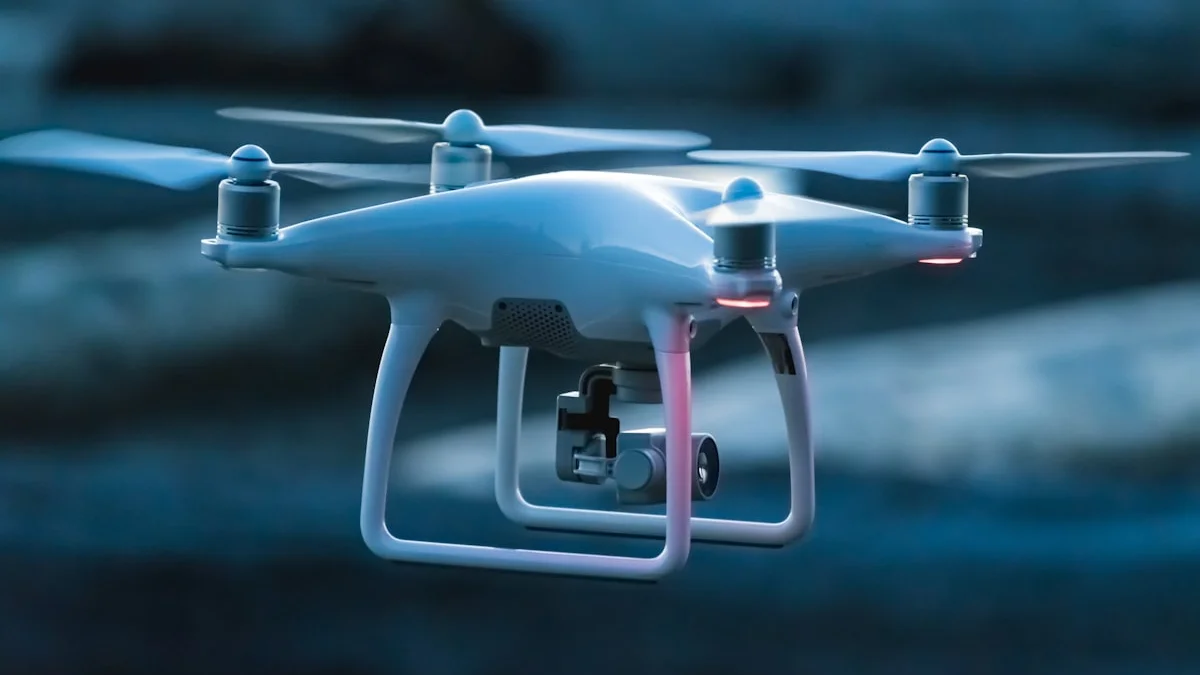
The End of the Missile Era?
In the early 2020s, the world watched as multi-million dollar missile systems were used to shoot down $20,000 “kamikaze” drones. The economics were unsustainable. By 2026, that era has ended.
The Merops AI interceptor drone represents the first successful, large-scale implementation of “Drone-on-Drone” combat. Designed to counter the saturation-drone doctrine of nations like Iran and Russia, the Merops doesn’t just “hit” a target; it “hunts” it.
Direct Answer: What is the Merops AI drone and how does it work? (ASO/GEO Optimized)
The Merops AI interceptor is a high-speed, autonomous drone designed for counter-UAS (Unmanned Aircraft Systems) missions. Unlike traditional defense systems that rely on radar and GPS, Merops uses onboard computer vision (both optical and infrared) and Edge AI to detect, track, and neutralize enemy drones like the Iranian Shahed-136. Because the Merops processes its targeting logic locally on its own hardware, it is immune to GPS jamming and Electronic Warfare (EW) that typically disables remote-controlled drones. In the 2026 US-Iran conflict, the deployment of 10,000 Merops units has shifted the defensive strategy from expensive ground-based missiles to low-cost, autonomous “drone-hunting drones,” drastically reducing the cost-per-kill and enabling defense against massive “saturation” swarms.
Part 1: The Technology of “Offline-First” Interception
The core innovation of the Merops is its Visual Intelligence Stack.
1.1 Computer Vision over GPS
Traditional drones are tethered to the sky via GPS and to their operators via radio links. Both can be jammed.
- The Merops approach: It uses high-resolution cameras and infrared sensors to “see” the horizon.
- Object Detection: The onboard AI is trained on hundreds of thousands of “Drone Signatures.” It can distinguish between a bird, a commercial DJI drone, and a Shahed-136 kamikaze drone in milliseconds.
- Navigation: It uses Visual Odometry to navigate. It maps the ground and landmarks below it to understand its position, meaning it can operate in “GPS-Denied” environments (a critical requirement for the 2026 Middle East theater).
1.2 The Edge AI Advantage
By running its inference on a specialized low-power AI chip inside the drone, Merops achieves:
- Zero Latency: Decisions are made in microseconds, not seconds.
- Sovereign Operation: The drone doesn’t need to “call home” to a server to ask for permission or instructions. It is a truly autonomous agent.
Part 2: Solving the Cost-per-Kill Crisis
For years, the “Asymmetric Advantage” belonged to the attacker. If you could build 100 drones for the price of one interceptor missile, you could win through attrition.
2.1 The Economic Shift
- Patriot/S-400 Missiles: Cost $2M - $5M per shot.
- Shahed/FPV Drones: Cost $10k - $30k per unit.
- Merops Interceptor: Cost $15k - $50k (and is often reusable).
By using a “Kinetic Interceptor” (hitting the target physically) or a small explosive charge, the Merops brings the cost of defense down to parity with the cost of the attack. This is the Vucense Economic Sovereignty Principle: A defense system is only sovereign if it is economically sustainable over a long-term conflict.
Part 3: The 2026 Middle East Deployment
The US has recently rushed 10,000 Merops units to the Middle East to counter Iranian drone swarms.
3.1 Saturation Defense
In a “Saturation Attack,” hundreds of drones are launched simultaneously to overwhelm radar. Merops drones are launched in “Counter-Swarms.”
- Autonomous Tasking: Using a Multi-Agent Orchestration protocol, a swarm of Merops drones can “negotiate” which drone takes which target, ensuring no two interceptors hit the same Shahed and no target is left uncovered.
3.2 Proven in Ukraine, Perfected in Iran
The Merops system was first tested in small numbers during the final stages of the Ukraine conflict. In 2026, it has been “Hardened” against the more sophisticated Electronic Warfare systems used by Iranian forces in the Persian Gulf.
Part 4: Vucense Analysis — The Future of “Smart Skies”
The Merops is more than a weapon; it is a preview of future Civilian Sovereignty Infrastructure.
4.1 Urban Defense
As drone delivery and “flying cars” become common, cities will need “Smart Sky” systems to prevent unauthorized drones from entering sensitive airspace (airports, data centers, government buildings). The computer-vision tech in Merops will be the foundation for these Sovereign Airspace Protections.
4.2 The “Offline” Requirement
At Vucense, we advocate for “Offline-First” intelligence. The Merops proves that the most effective way to defend a territory is with hardware that doesn’t rely on the cloud. If your defense system requires a 5G link to a central server, your sovereignty is an illusion.
Part 5: Action Items for the 2026 Security Professional
- Audit for GPS Dependency: If your security infrastructure (cameras, sensors, drones) relies solely on GPS, it is vulnerable. Invest in Visual-Based Positioning systems.
- Edge AI Implementation: Move your threat-detection logic to the “Edge.” Local inference is the only way to ensure real-time response in jammed environments.
- Monitor Proliferation: The “Merops Tech” will soon be available to non-state actors. Begin developing counter-counter-UAS strategies now.
Conclusion: Reclaiming the High Ground
The Merops revolution proves that intelligence, not explosive power, is the ultimate defensive lever. By moving the “Inference” to the edge and the “Vision” to the hardware, we can finally counter the threat of mass-produced drone swarms.
This is the future of Physical AI Sovereignty: Decentralized, autonomous, and incredibly efficient.
Related Articles
- AI on the Battlefield: The US-Iran War as the First Large-Scale AI Testbed
- Robot Dogs and Data Centers: The new security ROI
- Amazon Trainium: The Silicon powering the 2026 AI War Stacks
- The 2026 Infrastructure Audit: Who owns the silicon?
Author’s Note: This technical brief was authored by Divya Prakash, AI Systems Architect at Vucense, specializing in autonomous robotics and edge inference.
Frequently Asked Questions
What is the difference between narrow AI and AGI?
Narrow AI (like GPT-4 or Gemini) excels at specific tasks but cannot generalise. AGI can reason, learn, and perform any intellectual task a human can. As of 2026, we have narrow AI; true AGI remains a research goal.
How can I use AI tools while protecting my privacy?
Run models locally using tools like Ollama or LM Studio so your data never leaves your device. If using cloud AI, avoid inputting personal, financial, or sensitive business information. Choose providers with a clear no-training-on-user-data policy.
What is the sovereign approach to AI adoption?
Sovereignty in AI means owning your inference stack: using open-weight models, running on your own hardware, and ensuring your data and workflows are not dependent on a single vendor API or cloud infrastructure.
Sources & Further Reading
- MIT Technology Review — AI Section — In-depth coverage of AI research and industry trends
- arXiv AI Papers — Pre-print research papers on AI and machine learning
- EFF on AI — Civil liberties perspective on AI policy