Quick Answer: The shift to Local AI in 2026 means moving away from massive, cloud-based Large Language Models (LLMs) to Small Language Models (SLMs) that run directly on your personal devices. This transition leverages edge computing to improve data privacy, reduce costs, and give users complete control over their AI tools, a concept known as Compute Sovereignty.
The 2026 Shift to Local AI: Moving from Cloud Hype to Pragmatic SLMs
If 2025 was the year AI got a reality check, 2026 is the year it gets pragmatic. The tech industry is witnessing a monumental pivot away from the brute-force scaling of massive, cloud-bound Large Language Models (LLMs). Instead, the focus has shifted toward Small Language Models (SLMs) and edge computing—a transition that fundamentally redefines the architecture of modern AI.
At Vucense, we view this shift not just as a technical optimization, but as a major victory for Compute Sovereignty, giving users the power to run AI locally on consumer hardware without relying on Big Tech cloud infrastructure.
What Are Small Language Models (SLMs) and Why Are They Replacing LLMs?
For years, the narrative was simple: bigger is better. Models bloated into the trillions of parameters, requiring massive server farms and astronomical energy consumption. However, this approach centralized power in the hands of a few tech conglomerates and created severe privacy bottlenecks.
In 2026, enterprise and consumer applications are pivoting. Fine-tuned SLMs are proving that they can match the performance of out-of-the-box generalized models for specific tasks, but at a fraction of the cost and speed. When comparing the benefits of small language models vs LLMs, the advantages in efficiency and privacy are undeniable.
Key Benefits of Local AI and Compute Sovereignty
- Local Execution: SLMs are small enough to run on standard consumer hardware—from modern smartphones to desktop laptops. You can now perform local AI inference directly on your device.
- Data Privacy: Because the data never leaves the device, the risk of data scraping, prompt-injection attacks on centralized servers, and mass surveillance is practically eliminated. Edge computing AI privacy is the gold standard for enterprise security.
- Resilience and Offline Capabilities: Local AI works offline. Your tools shouldn’t stop working just because a cloud provider experiences an outage or decides to change their Terms of Service.
Edge Computing in 2026: Running AI Locally on Consumer Hardware
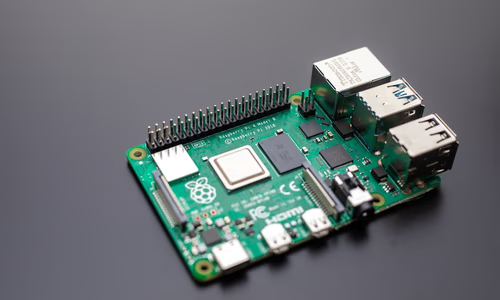
Advancements in edge computing are accelerating the future of AI compute sovereignty. With newer hardware built specifically to handle AI inference locally (such as dedicated Neural Processing Units or NPUs), the physical devices we use every day are becoming independent intelligence hubs.
By pushing the compute to the “edge” of the network, we are cutting out the middleman. Users are no longer just API endpoints for Big Tech; they are sovereign nodes in a decentralized intelligence network.
Frequently Asked Questions (FAQ)
What is a Small Language Model (SLM)? A Small Language Model (SLM) is a compact AI model designed to perform specific tasks efficiently. Unlike large, general-purpose LLMs, SLMs require less computing power and memory, making them ideal for running locally on phones, laptops, and edge devices.
Can I run AI locally offline? Yes. By using Small Language Models (SLMs) downloaded to your device, you can run AI locally without an internet connection, ensuring 100% data privacy and uninterrupted access.
How does edge computing improve AI privacy? Edge computing processes data locally on your device (the “edge” of the network) rather than sending it to a centralized cloud server. This means your personal information and prompts never leave your device, drastically reducing the risk of data breaches.
Conclusion
The transition from cloud-heavy AI to localized SLMs is the most significant privacy development of 2026. As AI moves from speculative hype to integrated pragmatism, the tools we use will become faster, cheaper, and—most importantly—ours. The shift to local AI is here to stay.
Why this matters in 2026
The shift to small language models on edge hardware is not a step backward — it is a strategic realignment. SLMs running on devices you own give you inference speed, privacy, and operational independence that a cloud API subscription cannot match for latency-sensitive or data-sensitive workloads.
That matters because the shift to small language models on edge hardware is not primarily a performance story — it is a control story. An SLM running on a device you own, with weights you can inspect, on a runtime you manage, gives every team the same sovereignty properties that were previously available only to organisations with the budget to run private cloud infrastructure.
Practical implications
- Prioritise AI systems that can interoperate with local data and on-premise tools, rather than locking you into a single vendor ecosystem.
- Treat agentic workflows as part of your sovereignty plan: ask who owns the model, who controls the data path, and how you recover if a provider changes terms.
- Use this story as a signal to review your AI governance and operational controls, not just your product roadmap.
What to do next
For engineering teams evaluating SLMs, the selection process should start with your data constraints rather than your capability wishlist: identify what information the model will process, where it must reside, and what latency your application requires. Models that satisfy those constraints are sovereign by design, not by accident.
How to apply this
For engineering teams evaluating SLMs, the inventory exercise is the foundation of the migration strategy: list every workload currently using a cloud LLM, classify each by latency requirement, data sensitivity, and inference cost, and identify the subset where a 7B or 13B parameter model running locally would deliver acceptable quality. That subset is your Phase 1 migration target.
What this means for sovereignty
The shift to SLMs is a practical expression of this principle: deploying a model you can inspect on hardware you control with a runtime environment you manage means your AI capability is sovereign in the full sense. The dataset is your fine-tuning corpus; the model is your weight file; the inference environment is your edge device or local server.
Sources & Further Reading
- MIT Technology Review — AI Section — In-depth coverage of AI research and industry trends
- arXiv AI Papers — Pre-print research papers on AI and machine learning
- EFF on AI — Civil liberties perspective on AI policy